
7th Grade Experience
Our seventh graders return from their summers with laughter and energy, their excitement at returning reverberating through the halls. The seventh grade team collaboratively guides the students with thoughtful enthusiasm using the phrase:
Use your Resources and Initiative
We want our students to develop an awareness of the resources available to them, as well as opportunities to take initiative. We use the shared language of, “Use your R & I,” to help further two main themes of seventh grade: "stretch your comfort zone" and "advocate for yourself."
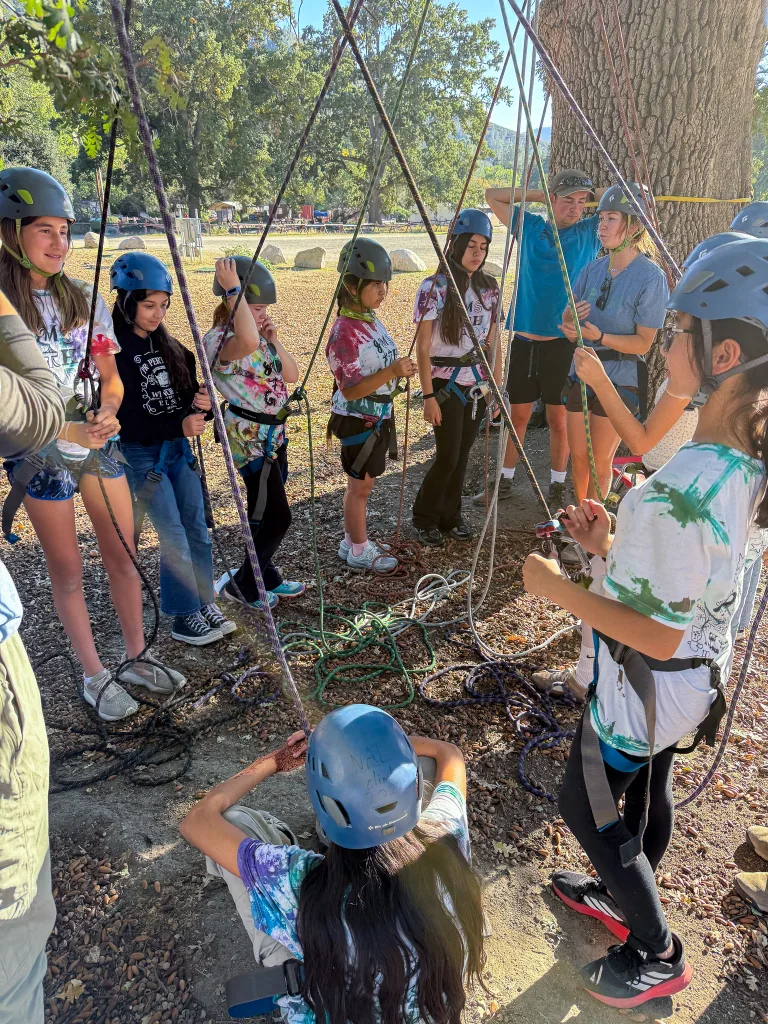
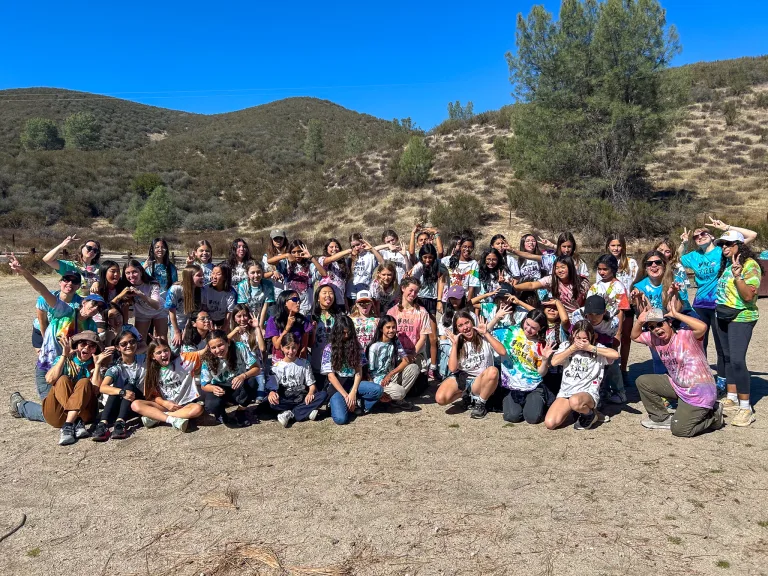
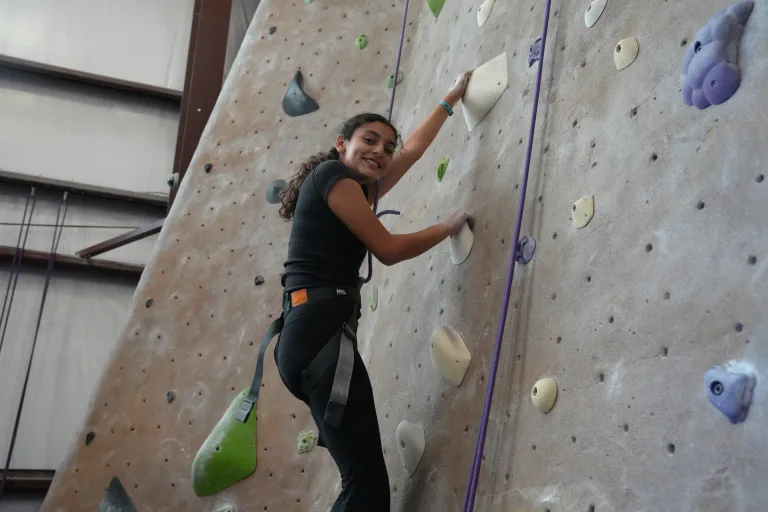
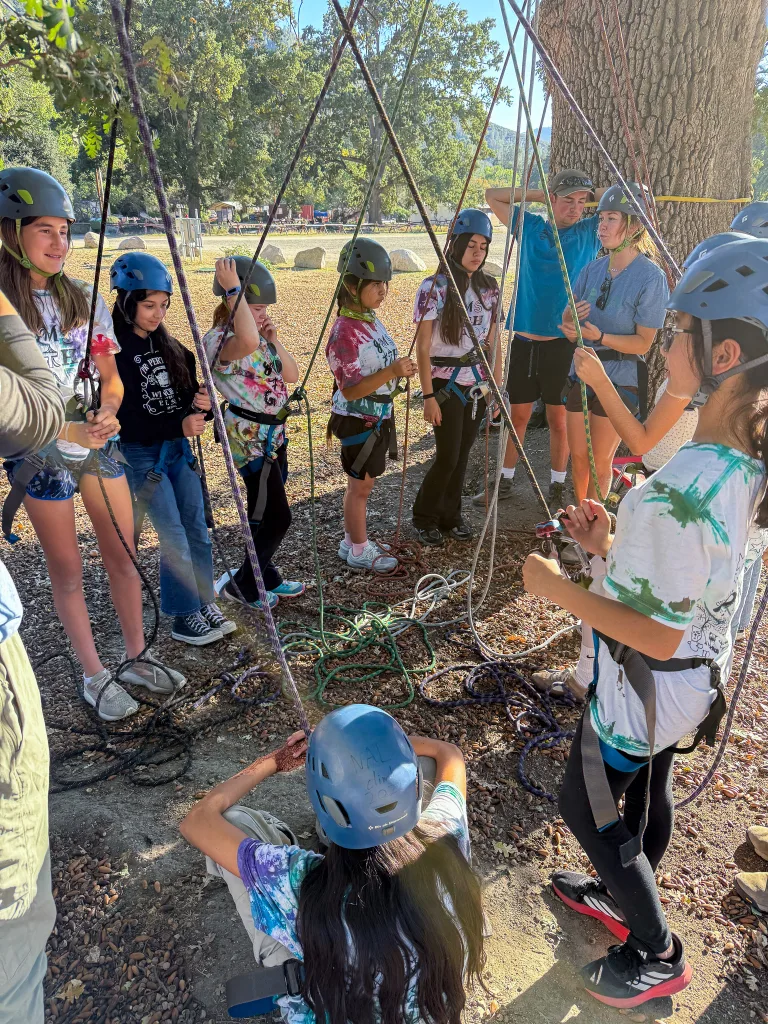
The seventh grade curriculum asks each girl to think about who she is as an individual and her place in the world. We provide opportunities for the students to think deeply about social situations, kindness, and new emotions and experiences. The teachers integrate the curriculum throughout the year so that a student can use her knowledge of the brain from Science class to further her research on a social issue in Humanities. The seventh graders launch these skills in the fall with a weeklong camping trip. As they develop a product and start a business in Entrepreneurial class, we help them grow as individuals and as a team through R & I. They are ready to take on the mantel of leaders of the school as they end the year in June.
7th Grade Curriculum
What We Teach
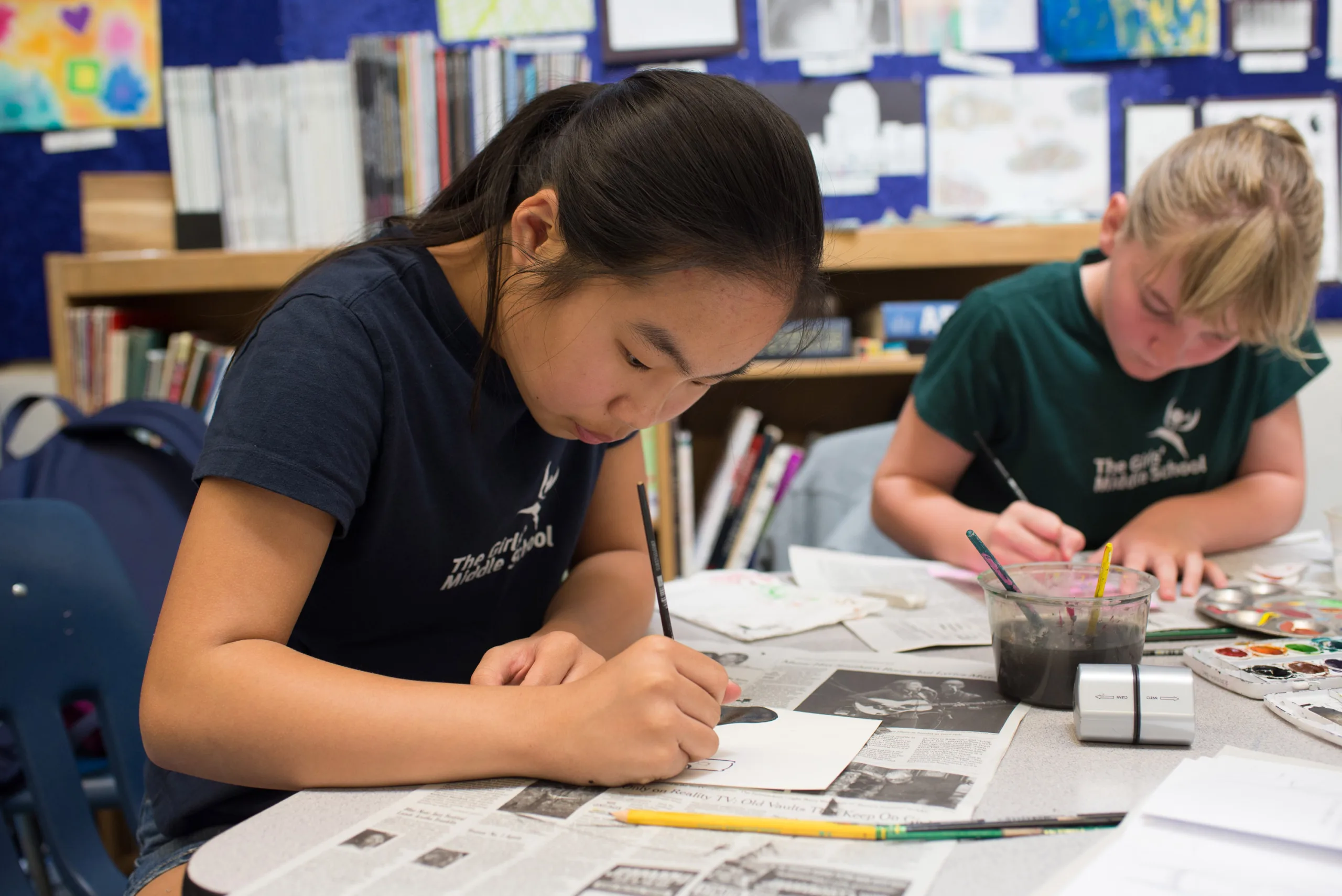
All GMS students have the opportunity to work not only in drawing and painting, but also in ceramics, woodworking, metalworking, music, drama, photography, and video production. In exploring these wide-ranging media and techniques, students gain confidence in their ability to experiment and take creative risks. At the same time, they are exposed to powerful tools for finding and expressing their voices and have opportunities to discover one or more ways to express their vision.
Why We Teach It
Serious engagement with a broad range of arts and media is central to the GMS approach to education. In these courses, students learn to be comfortable with pushing their limits, become creative problem solvers, and think critically about the visual, musical, and dramatic cultures of which they are both consumers and producers.
What We Teach
The GMS Computer Science curriculum provides a broad overview of concepts with an emphasis on programming skills and computational thinking. We address questions such as:
- How do computer hardware and software work together?
- How does the “design-code-test” cycle apply across different scenarios?
- How can we break down complex problems into basic building blocks?
GMS prepares students to identify which problems technology helps us solve and to express themselves through technological media. Through a variety of computer languages and tools, all students create effective and useful computer programs.
Why We Teach It
In today’s society, computer science is an essential tool. We prepare GMS students to sit at the table and be leaders in any field, and technology is no exception. We prepare them to identify which problems technology can help us solve, to express themselves and their interests through technological media, and to design and implement their ideas. Students experience the joy and satisfaction that comes from conversing with the computer and using it to devise new solutions, while gaining the confidence to apply computer science in creative ways in their lives.
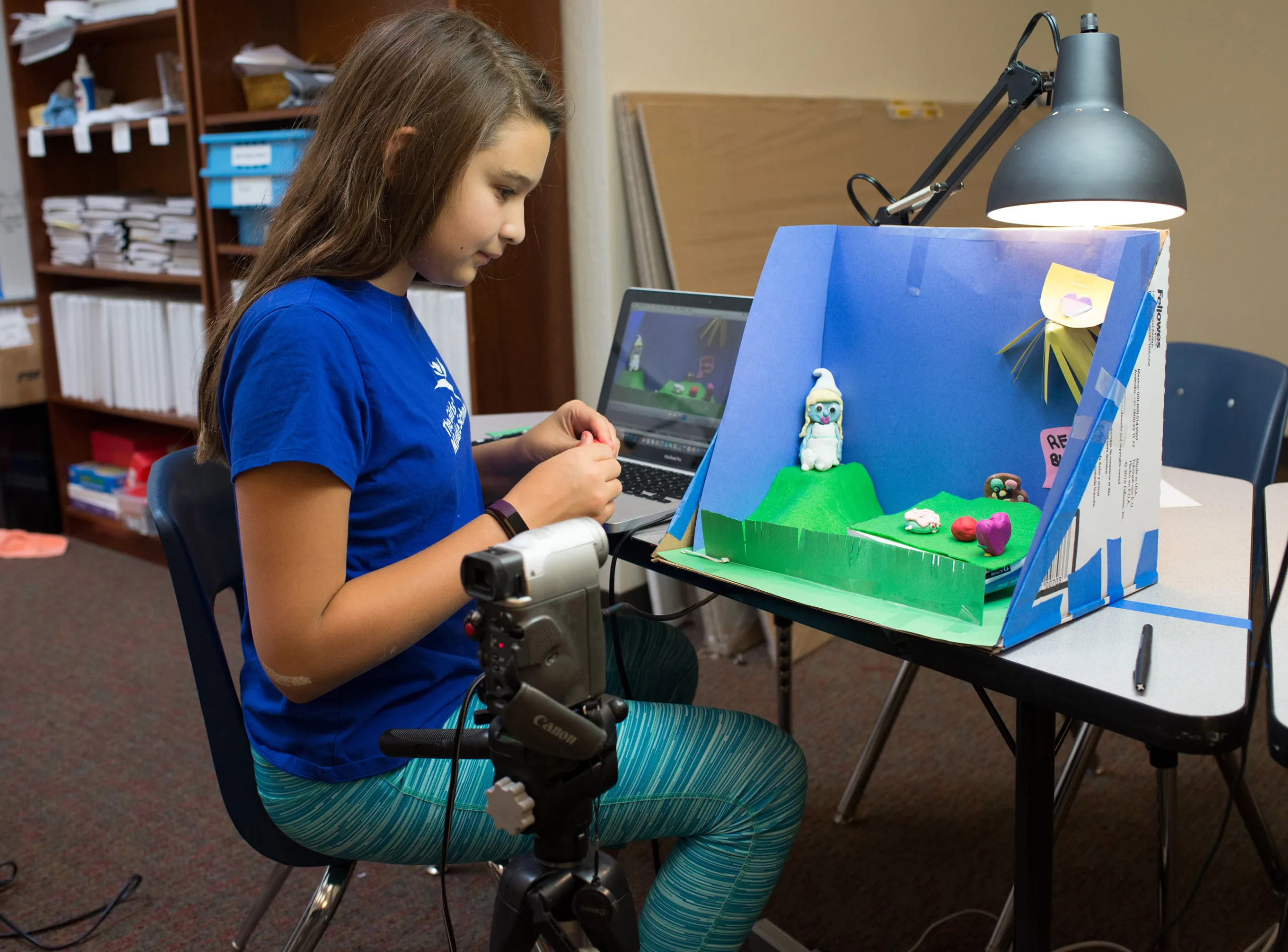
In seventh grade, students are introduced to text-based programming languages. They use this flexible and powerful programming environment to create more complex programs. As the intricacy of students’ programs grows, so must their ability to organize their code and break up large problems into manageable sub-problems. Throughout the year, students focus on strategies for organizing their ideas and programs in order to share them with others as well as deepen their own understanding.
Website Programming
Students learn how to use HTML and CSS to build websites with diverse content, stylish themes, and interactive components. We define the criteria for a professional website and work to develop the skills to meet the criteria. Students create websites that connect to their personal interests and support their Entrepreneurial company.
Algorithms and Ethics
Students learn about algorithmic programming and explore commonly used algorithms to explain a specific sorting algorithm in a presentation to their peers. Students also explore complex ethical dilemmas in technological advancement, including implicit bias in development and the surge of artificial intelligence technology in their daily lives. This unit culminates in a project where students invent or research a new or emerging technology as well as ethically critique a partner’s technology.
Introduction to Python Programming
Students begin their exploration of Python through the essential features of programming languages: output, input, storing data, making decisions, loops, and grouping. As each feature is introduced in Python, students consider why it is essential and how to creatively incorporate it into their programs. They also practice using the language to communicate their problem-solving strategies at different levels of detail.
What We Teach
The lessons acquired from the GMS Entrepreneurial Program are some of the school’s most profound and long lasting. The program builds on an insight underpinning all instruction at GMS: Project-based work offers the chance to go beyond content mastery. The students develop rarely taught 21st century skills in areas such as critical thinking, collaboration, creativity, and problem solving.
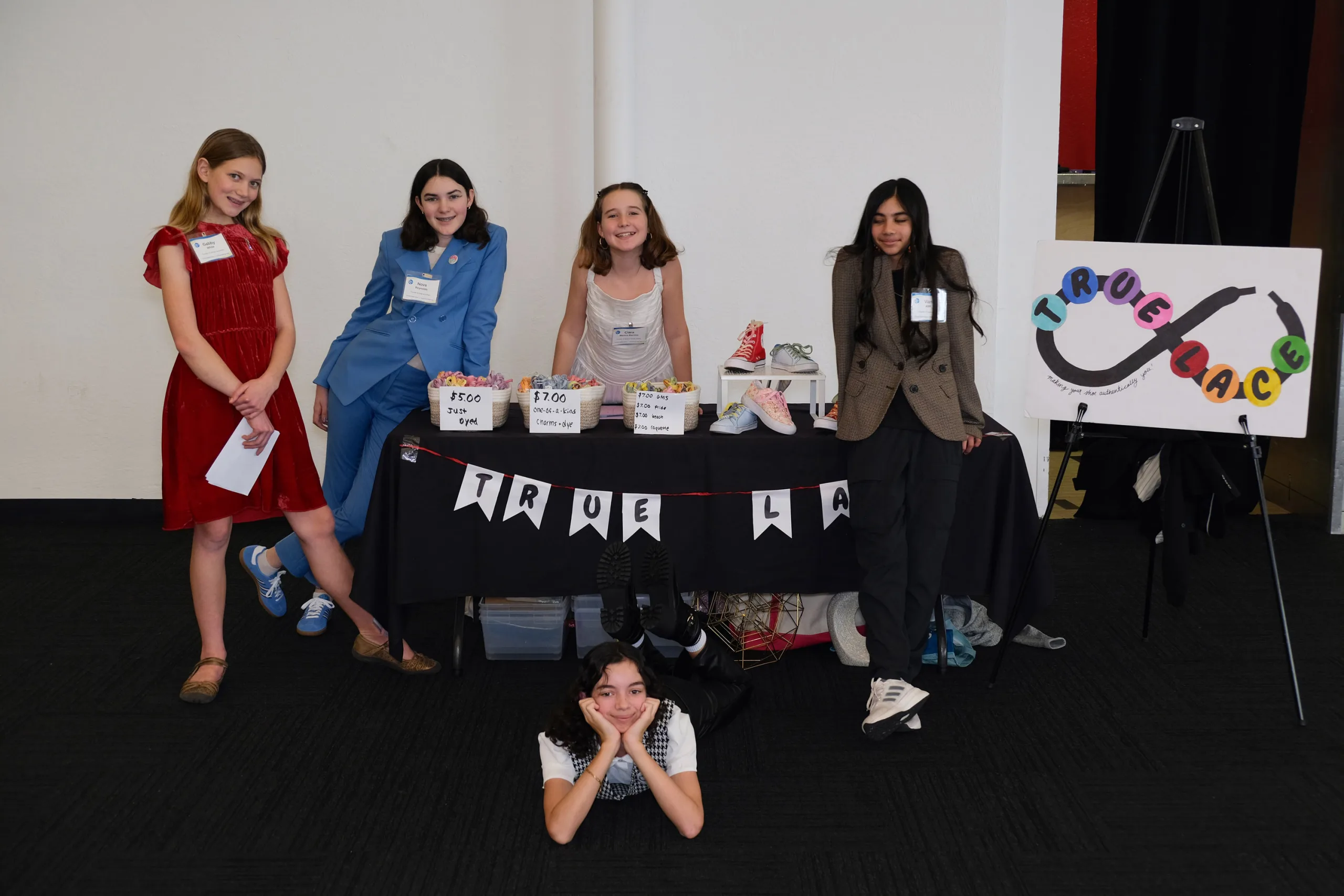
A year-long, interdisciplinary learning experience, our seventh grade entrepreneurship course challenges teams of students to design a novel physical product that they manufacture and market to both investors and customers. During the year, each team launches a small company with seed funding from the school. The course apex is a celebratory night during which students present their companies to a panel of respected Silicon Valley investors and sell their products to assembled community members
Why We Teach It
The Entrepreneurial Program affects each student in her own way, yet for every student it is a true highlight of their time at GMS. As they progress through the program, students develop strength in multiple areas including leadership and teamwork, creativity and product design, project and time management, mathematics and economics, communications and marketing, and public speaking. Just as importantly, they finish the program with an understanding of their own capabilities as contributors, leaders, and stronger self-advocates. They learn that girls can be creators of products as much as consumers of them.
What We Teach
The Humanities Department at The Girls’ Middle School integrates language arts with social sciences, an approach that encourages students to develop an awareness of themselves, their community, and the world. Beginning in sixth grade, students investigate what it means to be a member of a community, broadening their perspective and helping them to understand commonalities in the human experience. In seventh grade, students analyze American society by drawing connections between key literary works and major events in United States history, placing special emphasis on the contributions of changemakers and the perspectives of artists and authors. In eighth grade, students look through the lens of justice to study history, literature, and culture around the world. Through the process of reading, writing, listening, and speaking, students become independent and critical thinkers.
Why We Teach It
The GMS Humanities Department prepares our students to become powerful communicators, deep thinkers, and positive contributors to a just society. The curriculum encourages students to think critically and make connections to a wide range of texts and disciplines. We nurture and support creativity, growth, and expression, and students develop the ability to communicate their ideas thoughtfully and fluently throughout the process.
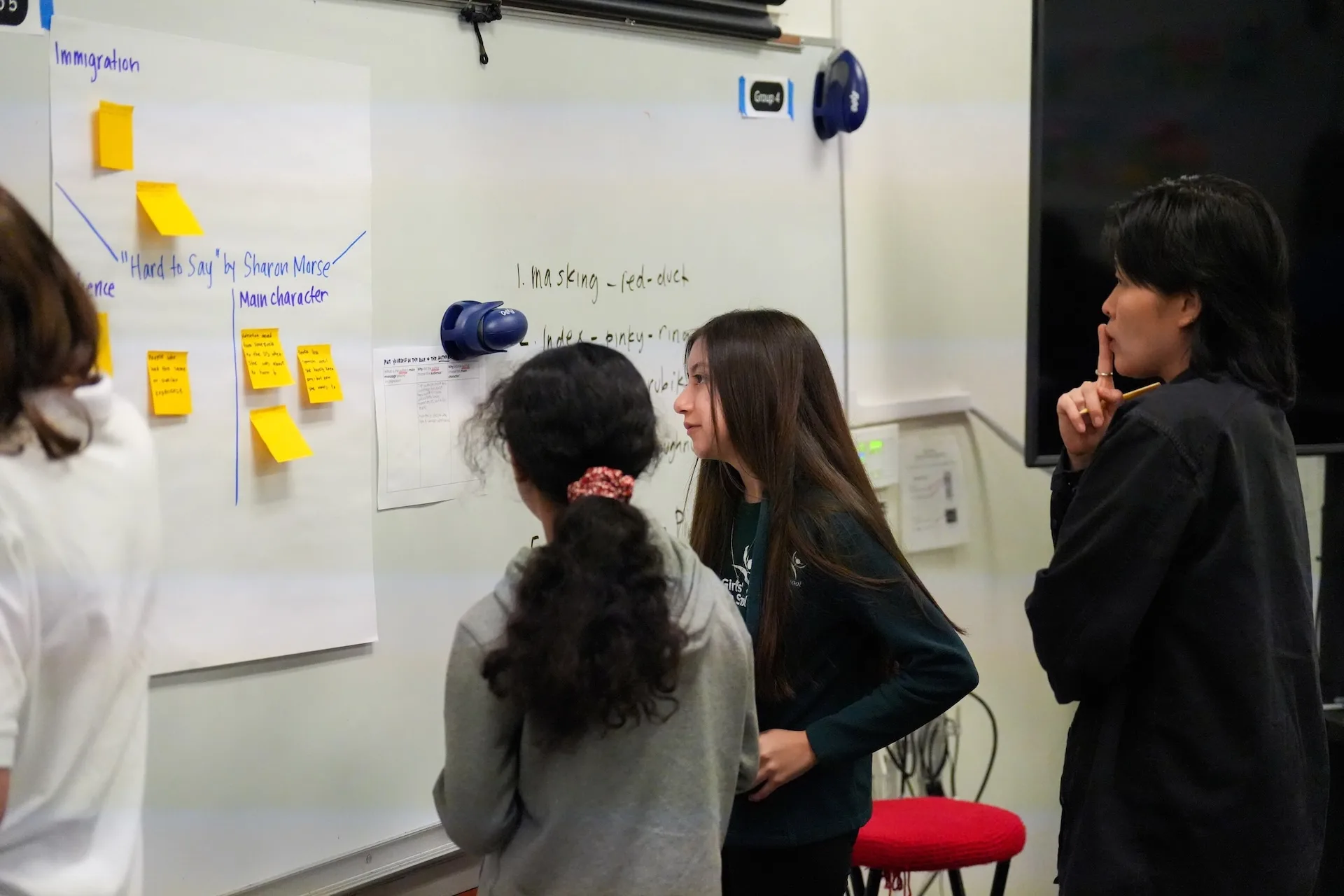
Seventh-grade Humanities builds upon the sixth-grade year by using history and literature as lenses to examine the human experience. Specifically, we focus our studies on American history and literature. By exploring the fundamentals of both historical and fictional societies, students are able to see how different ideologies impact the rights and values of individuals. In the 7th grade, students are asked to focus on two writing skills: crafting a structured assertion paragraph and defending an argument using evidence and analysis. Over the course of the year, students will develop their own authentic voices in their academic writing. Through critical reading, active discussion, and frequent writing, students gain a broader understanding of themselves, their society, and contemporary social issues.
Unit One | Rights and Values: United States of America
Essential Question: How do people pursue meaningful lives in society?
Major Texts: Excerpts from John Locke, The Declaration of Independence, The Constitution, The Bill of Rights, and the Iroquois Confederacy Constitution
Unit Two | Self and Society: Lois Lowry’s The Giver
Essential Question: Are individual freedoms essential? Why or why not?
Major Text: Lois Lowry’s The Giver
Unit Three | Expansion: Displacement, Immigration, and Migration
Essential Question: How does the expansion of a country impact the people living and moving there?
Major Texts: Shing Yin Khor’s The Legend of Auntie Po and primary and secondary sources focused on the experiences of Native nations and Chinese immigrants
Unit Four | Citizenship and Equality: American Civil Rights and Literature Circles
Essential Question: How have communities resisted the effects of prejudice and fought for more equitable and inclusive lives? What are the effects of prejudice on a society and the rights of individuals?
Major Texts: Young adult literature that addresses American women, Japanese Americans, Americans with disabilities, LGBTQ+ Americans, Latin Americans, and Black Americans
Representative texts: Helen Frost’s Crossing Stones, Jeanne Wakatsuki Houson’s Farewell to Manzanar, Sharon Draper’s Out of My Mind, Kyle Lukoff’s Too Bright to See, and Pablo Cartaya’s Each Tiny Spark
Unit Five | Empowerment: Poetry and Short Stories from Modern America
Essential Question: How is literature used to make change?
Major Texts: Poetry by Amanda Gorman and Maya Angelou, Ted Chiang’s “The Great Silence,” and short stories from Come On In: 15 Stories About Immigration and Finding Home, edited by Adi Alsaid
Unit Six | Human Nature and Morality: Arthur Miller’s The Crucible
Essential Question: How does a society’s ideology shape its rules, values, beliefs, relationships between citizens, and language?
Major Texts: Arthur Miller’s The Crucible, Mean Girls by Tina Fey, and excerpt from John Winthrop’s “City on a Hill” speech
What We Teach
In a GMS math class, students investigate, communicate, and solve problems; they discover connections between concepts through deep exploration, not through the memorization of algorithms. Group conversations are central to our curriculum, CPM Educational Program. These discussions uncover multiple solving strategies, representations, and ways of thinking.
Sixth grade is a foundational year; students learn to articulate their reasoning, which helps build their number sense. In seventh grade, students continue to develop their problem solving, proportional reasoning, and abstract algebraic understanding. Emphasis is placed on a foundation of linear equations and geometric relationships. By the end of eighth grade, all students complete the equivalent of a Common Core State Standards High School Algebra I course, which includes linear, quadratic, and exponential functions, as well as the modeling of single and bi-variate data.
Why We Teach It
The math department teaches the way we do because we want to encourage an enthusiasm towards math. We intentionally create meaningful experiences in the classroom that lead students to discover and understand underlying mathematical principles. We want all students to appreciate the inherent beauty of math; through collaboration in class, we hope to foster a sense of wonder and fun!
Every day, we aim for students to:
- Be pattern seekers and view the world through “math eyes.”
- Use the following five ways of thinking to approach mathematics – justifying, generalizing, making connections, reversing thinking, and applying and extending understanding.
- Develop mathematical reasoning skills and persevere in solving complex problems. Effectively communicate their thinking about mathematical concepts in written, oral, and graphic form.
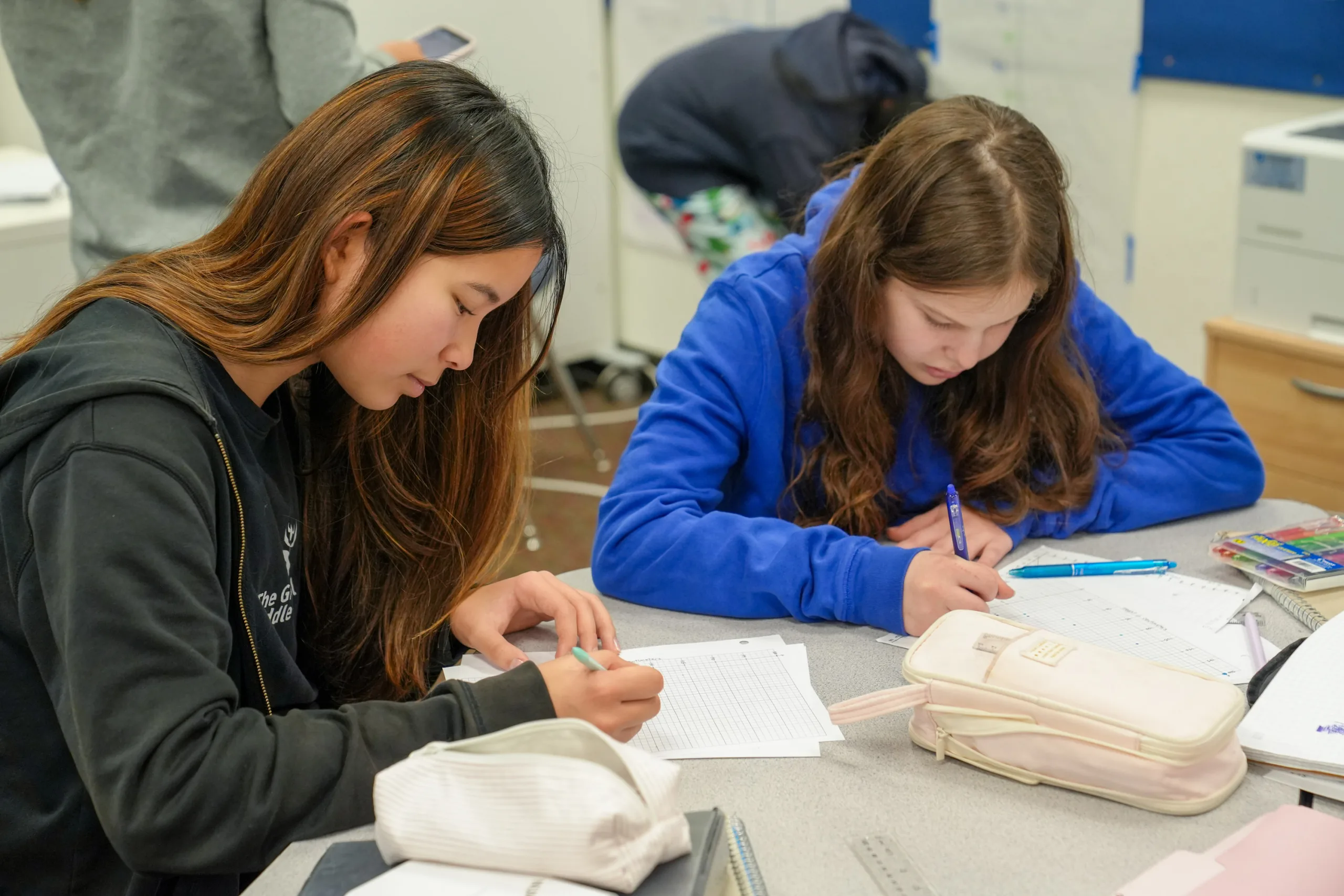
Seventh graders complete a Pre-Algebra curriculum, CPM Core Connections Courses 2 and 3. The curriculum asks the students to employ various strategies, question and investigate, find and construct evidence, analyze critically, and rigorously justify their thinking. The course focuses on problem-solving and on allowing students to discover generalizations and mathematical principles through exploration. This curriculum guides the students toward understanding the reasons behind the math.
Units of Study
Unit 1: Problem Solving and Simplifying with Variables
Unit 2: Graphs and Equations, Multiple Representations
Unit 3: Systems of Equations
Unit 4: Proportions and Percents
Unit 5: Statistics and Angle Relationships
Unit 6: Circles and Volume
Unit 7: Transformations and Similarity
Unit 8: Slope and Association
Unit 9: Exponents and Functions
Unit 10: Angles and the Pythagorean Theorem
Unit 11: Surface Area and Volume
What We Teach
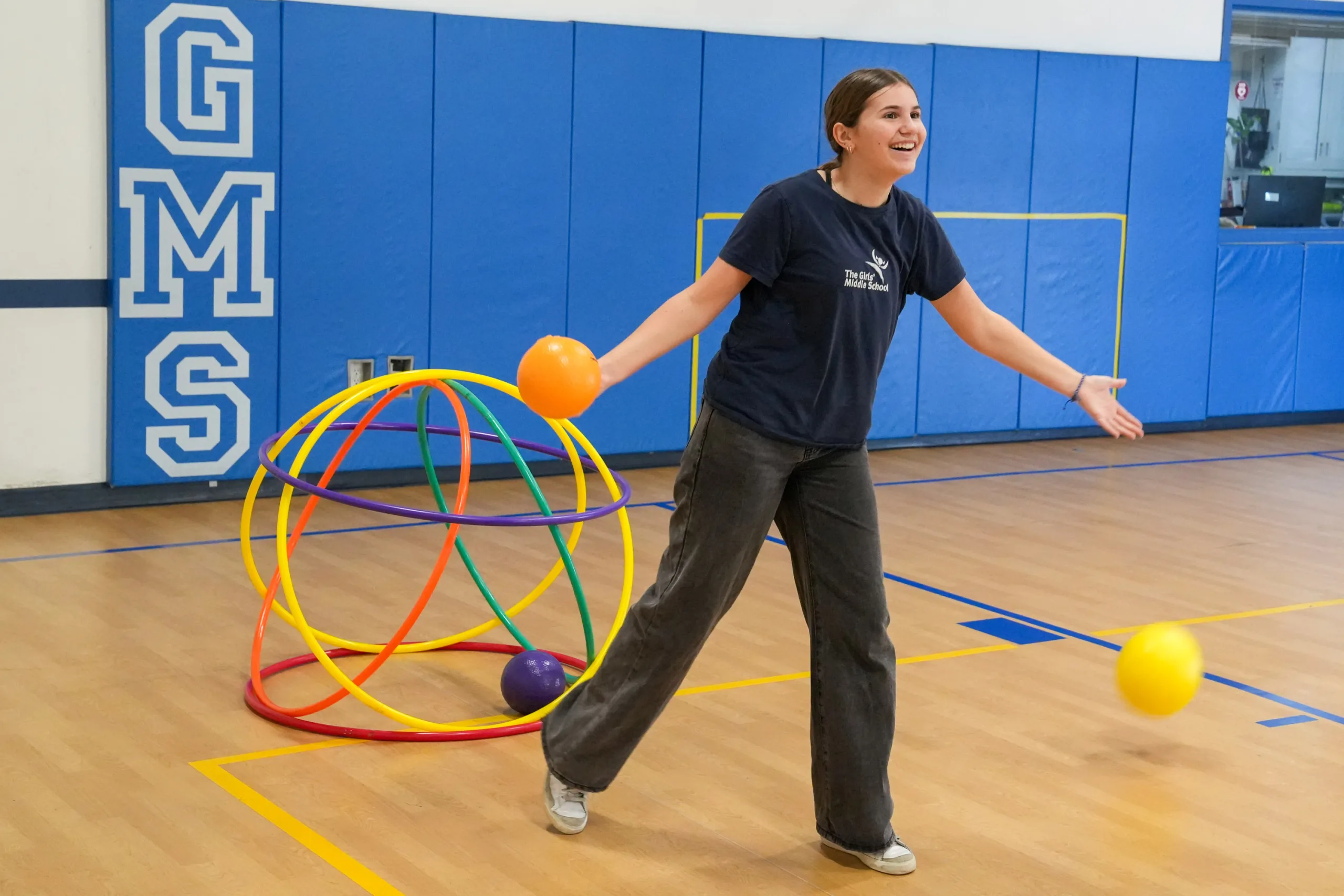
Physical Education classes include traditional sports such as basketball and volleyball, as well as nontraditional activities such as self-defense and skateboarding. GMS is proud to have a covered skateboard ramp and all of the necessary equipment to run a skate program. Highlights of the rainy season include fitness and African dance. Students are able to track their athletic improvement through fitness tests and various team challenges.
Girls discover sports by playing games to learn the rules and techniques rather than practicing repetitive drills. This approach to learning allows all girls to participate in every PE class and to work as a team to help each other improve. Units of study include softball, soccer, basketball, volleyball, lacrosse, tennis, flag football, track and field, fitness, running, African dance, self-defense, and skateboarding.
Why We Teach It
The physical education curriculum teaches the importance of being and staying healthy, and gives GMS girls the opportunity to learn and play sports in a positive environment. Making PE classes fun draws the students in, and they participate and exercise because they enjoy it. Finding the right type of exercise for each girl, whether a team or individual sport, is the goal. All students are expected to be involved to some degree all of the time. Students will test their skills at the end of a unit by competing in tournaments and playing on randomly organized teams.
What We Teach
The GMS science curriculum focuses on building science skills across students’ three years as they move through different disciplines. Sixth-grade students study Earth Science, which includes exploring Earth’s systems and Earth’s place in space. In seventh-grade Life Science, students study evolution, body systems, and science ethics, growing an understanding of the relevance and importance of science to our bodies and lives. Eighth-grade Physical Science includes both chemistry and physics using hands-on experiments to better understand how the world works and why taking care of our world matters.
Why We Teach It
We believe that science is accessible to every student. Each student’s inquisitive mind already makes them a scientist. In the words of Ellen Ochoa, the first Latina astronaut in space, “Curiosity is probably one of the most important characteristics that people have who go into science.” Science is a natural process of observing phenomena, wondering how the world works, and searching for answers in order to make sense of the world. Every student at The Girls’ Middle School is a scientist who learns and practices the skills that professional scientists use in their daily endeavors. Because science is a way of understanding the world around us, rather than a collection of vocabulary words and facts, the students engage in many hands-on explorations, inquiries, and projects as they explore the natural world.
Life Science
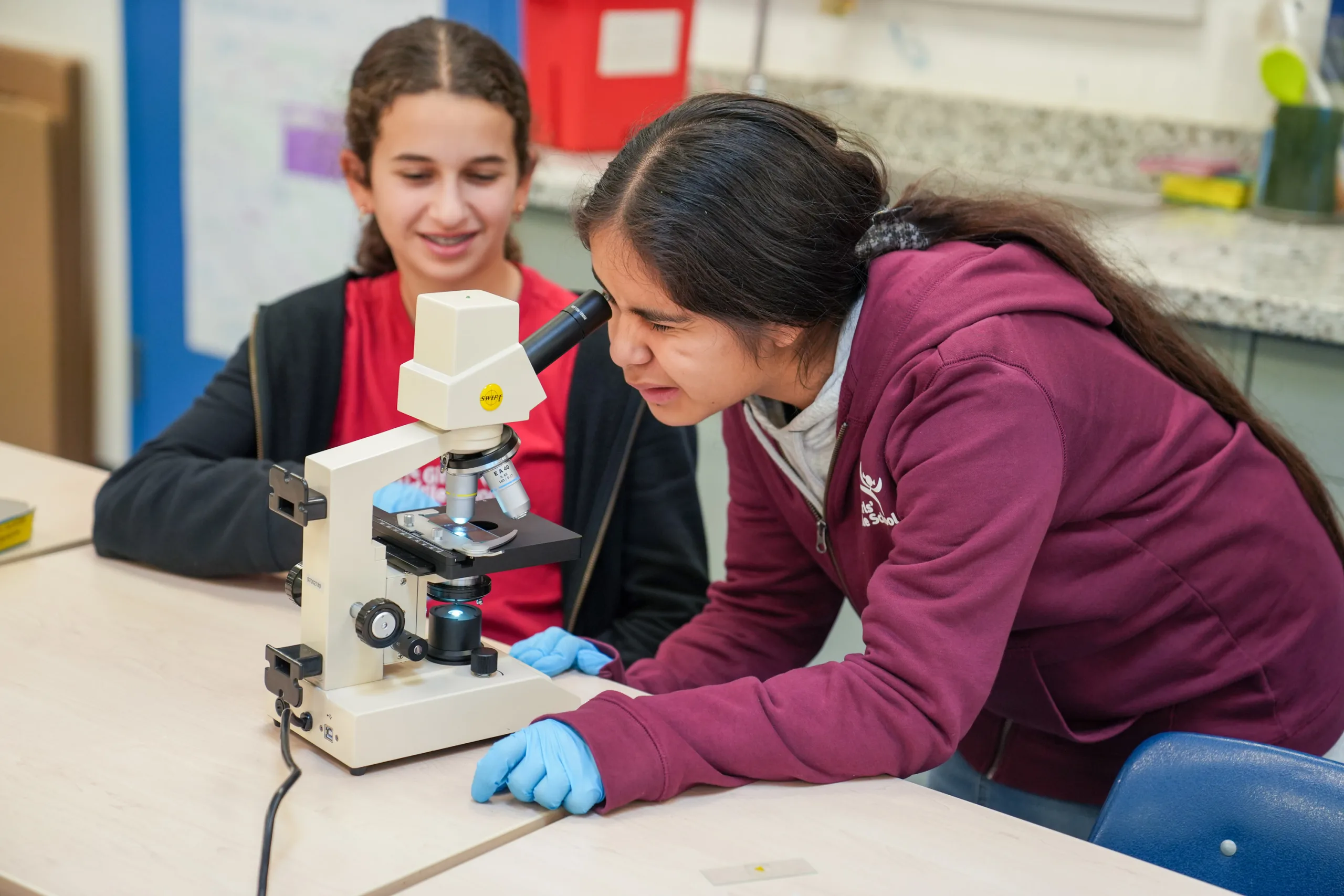
This year, students hone their scientific reasoning and critical thinking skills while learning about the living world. Students begin the year thinking about evolution and how it shapes all living things. By practicing evolutionary biology reasoning early in the year, students equip themselves to answer many of their own “why” questions about how organisms function in future units. Students then work their way from small to big in the human body, starting with understanding genetics and what their DNA can and can’t determine about them. Next, they master microscopes while looking at cells and learning about how humans grow from a single cell to a baby. Students then dive into human body systems before finishing the year with a research project that allows them to develop their own informed opinion about a real-world science issue of today.
What We Teach
The Social and Emotional Learning (SEL) Program at The Girls’ Middle School supports every GMS student in their transition into the teenage years, providing them with the skills necessary to develop into a strong, healthy, self-aware young person. In a course that meets weekly for all three years at GMS, students have a safe space to explore complex issues. Within this framework, the SEL course addresses numerous topics of concern to teens with both candor and sensitivity. These include effective communication skills, values clarification, healthy relationships, conflict resolution, human sexuality, drug education, diversity, and self-awareness.
Why We Teach It
In SEL, emphasis is placed on creating a caring and compassionate environment in which adolescents learn that they are supported, as well as how to support one another. The class provides the time and space for GMS students to build healthy identities, examine their own internal worlds, and begin to understand themselves and expand their autonomy, which is central to adolescent development.
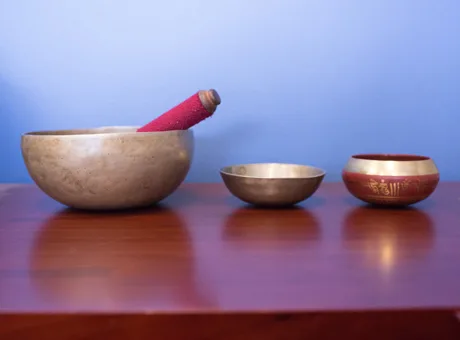
Seventh grade SEL continues to promote and deepen the skills learned in sixth grade. Emphasis is placed on group cooperation, building empathy, and understanding one’s self and others. In seventh grade we invite the students to be introspective, specifically identifying their personal response to conflict and how it plays out in their relationships. The Human Sexuality Unit incorporates the idea of choice and consequences, with sometimes-profound conversations about why people make particular life choices, and how to apply these insights to their own decision-making.
What We Teach
The Spanish department’s mission is to encourage students to appreciate and connect language and culture to the real world by improving their understanding of Spanish. Advancing students’ speaking, listening, and writing skills, while motivating them to learn and love Spanish, reinforces the importance of being bilingual in California. Each student understands that learning Spanish requires focus, motivation, practice, and a willingness to use Spanish during classroom activities and on a daily basis.
Spanish classes at GMS help improve fluent and non-fluent speakers’ literacy skills; however, it takes more than just skills to become a fluent or successful Spanish speaker. At GMS, each student engages in an individual and group Spanish-learning process that embraces an inclusive learning environment with engaging discourse and innovative instructional technology. Providing a respectful, rich, and safe classroom environment ensures that every student is able to apply herself, take risks, make and rectify mistakes, and work on her understanding and use of the language during her three years in the GMS Spanish Language Program
Why We Teach It
Spanish at GMS is an interactive program designed to provide a rich learning environment to our students. In both the fluent and the non-fluent speakers’ classes, students experience an engaging learning environment that uses challenging, exciting, and fun Spanish activities in the classroom and within the Latino community to enhance understanding of the Spanish language and its diverse culture and heritage.
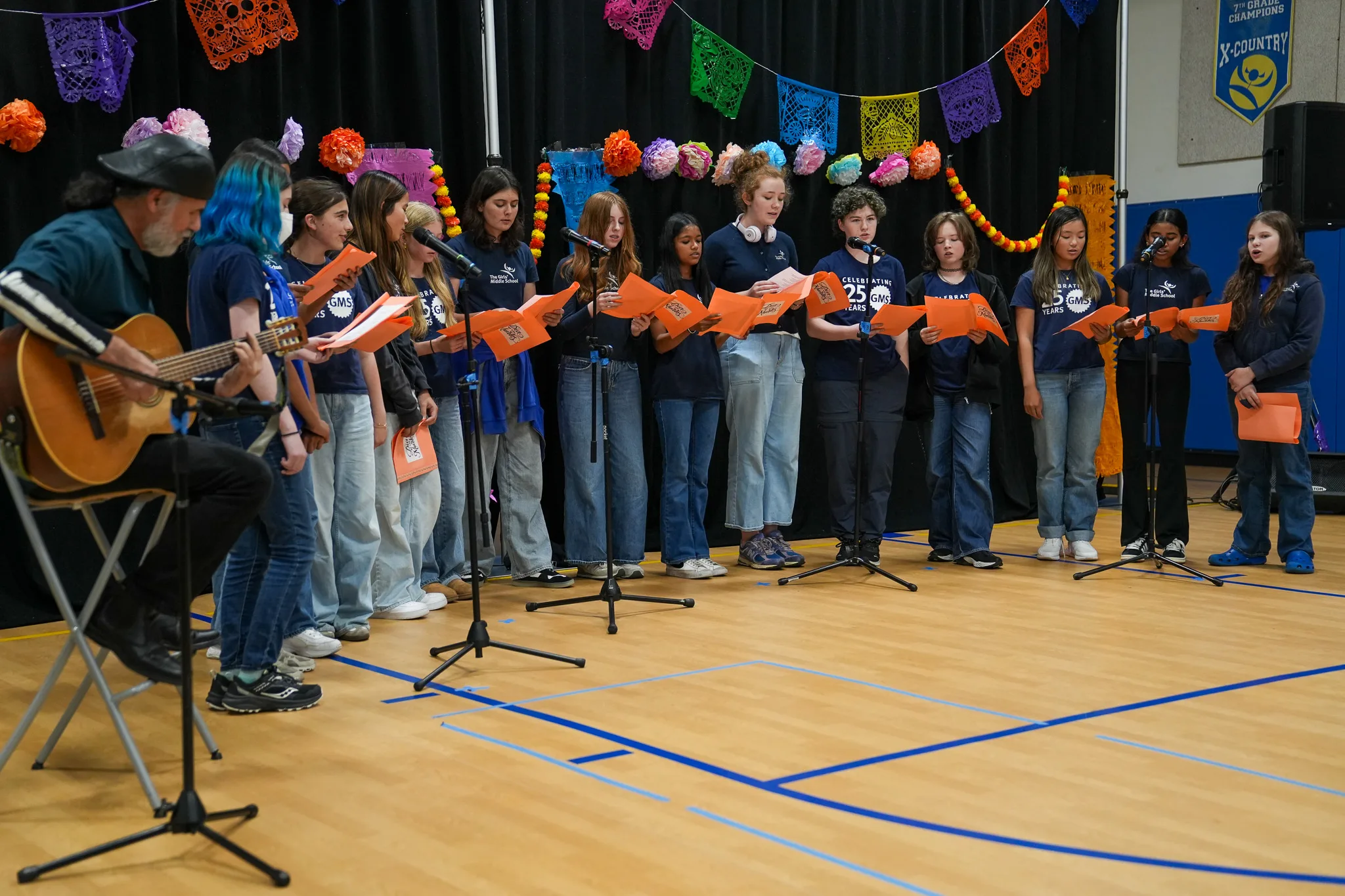
This course provides students with a deeper understanding of the connection between language and culture, with emphasis on listening, speaking, reading, and writing skills. Students read a short novel to expand their vocabulary, practice complex grammar and sentence structure, write paragraphs, and their first essay in Spanish. Students also improve their proficiency in the language through the use of Total Physical Response (TPR) technique. They are involved in a variety of cultural activities, videos, music, group, and individual projects. Students reinforce their grammar skills with the workbook, Español Esencial I. They use Rosetta Stone and other technology resources to enrich their learning.
Unit 1: Communication Alive – What is the importance of learning Spanish in the US?
Students seek the connection between language and culture by reflecting on the importance of learning Spanish in the United States. They also learn about the many countries around the world that speak Spanish. The students reflect on their own cultural background. Project: ¿Quién soy yo?
Unit 2: Day of The Dead – What represents the Day of The Dead in Mexican Culture?
This unit focuses on an ancient indigenous Mexican holiday and has the objective of enriching cultural appreciation, values, and traditions from other cultures. Students make linguistic and cultural connections through hands-on activities as they prepare for the ceremony of The Day of the Dead.
Unit 3: Daily Routines – What do you like and what do you dislike?
Students develop abilities to listen, speak, read, and write about diverse topics in small conversations, daily routines, and written exercises. Project: Me gusta y no me gusta.
Unit 4: Culture and Language Connection
Students learn real and fantasy stories while developing reading comprehension skills and answer basic questionnaires related to the books. Project: Select a Spanish language poem.
Unit 5: Reading and Oral Performance
Students engage in hands-on activities by translating, working on pronunciation and memorizing Spanish language poetry. Students also read and comprehend a brief Spanish book. Text: Pobre Ana
Unit 6: Poetry and Paragraphs
Students engage in hands-on activities by learning various techniques for memorizing and performing a Spanish language poem in front of the group. Students also are guided with grammar tools for writing Spanish paragraphs. Text: Pobre Ana and selected poem.
Unit 7: Mexican Culture
Students engage in diverse activities in the classroom by making linguistic and cultural observations through texts and real situations connected with Latino community. Project: Ordering food in a Mexican restaurant.
This course introduces students to the narrative of the language. Throughout the process of exploring their ability to write and talk about different kinds of texts, they learn new vocabulary and reinforce their capacity to use various grammatical structures. It is a crucial step toward refining their spoken and written proficiency. By reading and understanding different points of view and writing styles, students are encouraged to use their creativity to create stories and to make connections between the units of study and their immediate world.
Unit 1: Narrative and Grammatical Structures – Stories
How can I relate the formal model for story structure to the structure of a short story? What tense do we use to narrate a story? Students learn characteristics of story tales that help them develop an appreciation of this genre of Latino-American fiction; they plan and write their story tales. Texts: We read the following short stories “El buscador,” “El rey y el mago,” and “La abuela grillo.”
Unit 2: The Day of the Dead in the Mexican Culture
This unit focuses on an ancient indigenous Mexican holiday and has the objective of enriching cultural appreciation, values, and traditions from other cultures.
Unit 3: Narrative and Grammatical Structures – the novel and descriptive text
How do you write a descriptive text? Students use their imagination to write descriptive texts using correct tenses and punctuation. Text: Esperanza Renace
Unit 4: Narrative and Grammatical Structures – Dialogue
This unit focuses on solidifying grammar rules and structures to improve writing skills, with a focus on writing detailed dialogue. Text: Esperanza Renace
Unit 5: Narrative and Grammatical Structures – Poetry
How do I understand poetry? In this unit, students explore poetry as a medium of written and spoken expression by using diverse literary resources. Text: Esperanza Renace
Unit 6: Narrative and Grammatical Structures – Speech
How can I prepare a speech? How can I be persuasive in a speech? Students write speeches by following a grammatical structure, and connect their grammar and spelling rules in their writing process. Texts: El libro perdido and El bosque de piedra
Unit 7: Narrative and Grammatical Structures – Portfolio
What did I learn this year? How can I write a summary? Students create a portfolio including a review of all concepts, grammar structures, tenses, and spelling rules. Text: Devolver al remitente